
Patagonia Trek
Patagonia is the southern part of Argentina and Chile including a diverse landscape of grasslands, mountains, glaciers, and temperate rainforest. Our trip will focus on two of the world’s most famous trekking locations: Los Glaciares National Park in Argentina from El Chaltén and Torres del Paine National Park in Chile near Puerto Natales. Joe has trekked and climbed in Patagonia on six previous trips.
Most people fly into Buenos Aires, the capital and largest city in Argentina. It’s another four-hour flight from Buenos Aires to El Calafate where we’ll meet and drive together to Puerto Natales for trekking in Torres del Paine, and then north to El Chaltén for trekking in Los Glaciares National Park.
Date
Nov 9-19, 2026 (private trip)
Booking
Contact Joe with questions and ideas
Up to five clients
Important Links
CDC Traveler’s Health: wwwnc.cdc.gov/travel/destinations/traveler/none/argentina
Solo Lofts in El Chaltén: solo-lofts.com/en/index.html
Nov 8 Hotel: Altos de Soberana in El Calafate, altosdesoberanacalafate.com.ar/
Torres del Paine trek: vertice.travel/servicios/5d-west-w-circuit-self-guide/
Our local guide in El Chaltén: chaltenmountainguides.com/en
Gear list: stockalpine.com/s/Patagonia-Trekking-Gear-List.pdf
International terms and conditions: stockalpine.com/s/Terms-and-Conditions.pdf
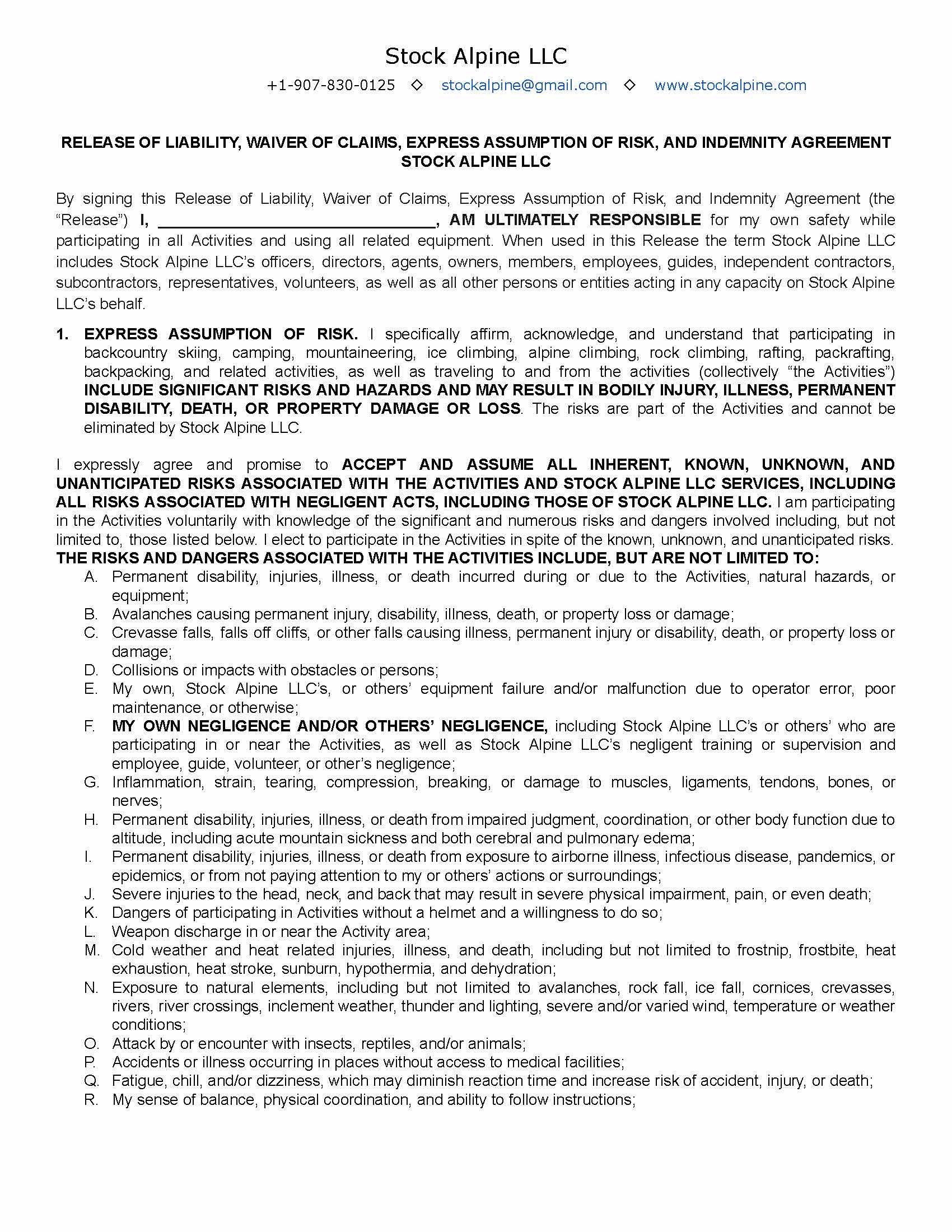
Adult waiver: stockalpine.com/s/Liability-Waiver-Adult-Stock-Alpine-LLC.pdf
Itinerary
D0, Nov 8: Arrive in El Calafate. Joe will meet you at the airport in our rental car. He will be finishing a trip in Ushuaia on Nov 5 and will be in the area before we meet. Gear check and group welcome dinner. Night at Altos de Soberana in El Calafate.
D1, Nov 9: Drive to Puerto Natales. Today is a five hour drive through the beautiful desert steppe of Patagonia from El Calafate to Puerto Natales. Night at Sheuen Patagonia in Puerto Natales.
D2, Nov 10: Hike Lago Torres. This is a big day. We’ll have an early breakfast and leave at 7am. After an hour drive we will arrive at the park entrance and check in with CONAF (park rangers), the Cerro Paine Reserve at the visitor’s center, and at Torre Central where we will leave our extra trekking luggage. Today’s hike to Lago Torre for views of the towers is the most famous hike in Torres del Paine. It is a long out and back hike, which means the hike can be cut short if folks are tired. Return to Torre Central to camp for the night.
Time: 8-10 hours
Elevation: +3,200 feet
Distance: 14 miles (21 km)
D3, Nov 11: Hike Torre Central to Los Cuernos or Francés. From the park entrance at Torre Central we’ll hike along Nordenskjöld Lake to Los Cuernos or Francés to camp for the night.
Time: 5 hours
Elevation: +2,000 feet
Distance: 10 miles (16 km)
D4, Nov 12: Hike Los Cuernos, French Valley, Paine Grande. We’ll hike to the Italiano Campsite where we’ll leave our extra gear while we day hike into the French Valley. After returning to Italiano, we’ll collect our gear and keep hiking to Paine Grande to camp for the night.
Time: 7 hours
Elevation: +1,750 feet
Distance: 10 miles (16 km)
D5, Nov 13: Hike to Paine Grande to Grey Glacier. We’ll hike along the edge of Grey Lake with views of the Grey Glacier. Camp at Grey refuge.
Time: 5 hours
Elevation: +1,400 feet
Distance: 7 miles (11 km)
D6, Nov 14: Hike Grey to Paine Grande and travel to Puerto Natales. Optional morning 3-4 hour hike to the hanging bridges for views of the Grey Glacier. Hike back to Paine Grande, catamaran to Pudeto, bus to Puerto Natales. Night at Cabañas Los Coihues in Puerto Natales.
Time: 5 hours
Elevation: +1,300 feet
Distance: 7 miles (11 km)
D7, Nov 15: Travel to El Chaltén. Drive (8 hours, 417 km) from Puerto Natales to El Chaltén. We’ll stop for lunch and views along the way. Night at Solo Lofts in El Chaltén.
D8, Nov 16: Rest and Hike Los Condores. After a slow morning, we will do an optional short hike to Los Condores and Las Aguilas lookouts. Spend the afternoon checking out El Chaltén. Night at Solo Lofts in El Chaltén.
Time: 2 hours
Elevation: +600 feet
Distance: 3 miles
D9, Nov 17: Hike Laguna Torre. Not to be missed, hike to Laguna Torre for views of Cerro Torre. Night at Solo Lofts in El Chaltén.
Time: 6 hours
Elevation: +1,200 feet
Distance: 11 miles
D10, Nov 18: Hike Laguna de los Tres. A traverse with a side trip to the famous Fitz Roy viewpoint at Laguna de los Tres Traverse. Night at Solo Lofts in El Chaltén.
Time: 10 hours
Elevation: +3,000 feet
Distance: 13 miles
D11, Nov 19: Fly home from El Calafate in the afternoon. We will leave El Chaltén early to drive three hours to the El Calafate airport. Joe flies from El Calafate to Buenos Aires at 13:30 on Aerolineas Argentina flight AR1897. He has a short layover in Buenos Aires before flying onto Los Angeles.
Patagonia

El Chaltén Treks
These are day treks from our base in El Chaltén, so they are all optional and flexible based on your interest.
Los Cóndores Las Águilas: A shorter hike for when we first get there. 4 miles, +600 feet.
Laguna de los Tres: A traverse with a side trip to the famous Fitz Roy viewpoint. 13 miles, 3,000 feet.
Laguna Torre: An out and back to the famous Cerro Torre viewpoint. 11 miles, +1,200 feet.
Tumbado: Optional long hike out and back to a summit with views and no crowds. 12 miles, +3,640 feet.

Torres del Paine Trek
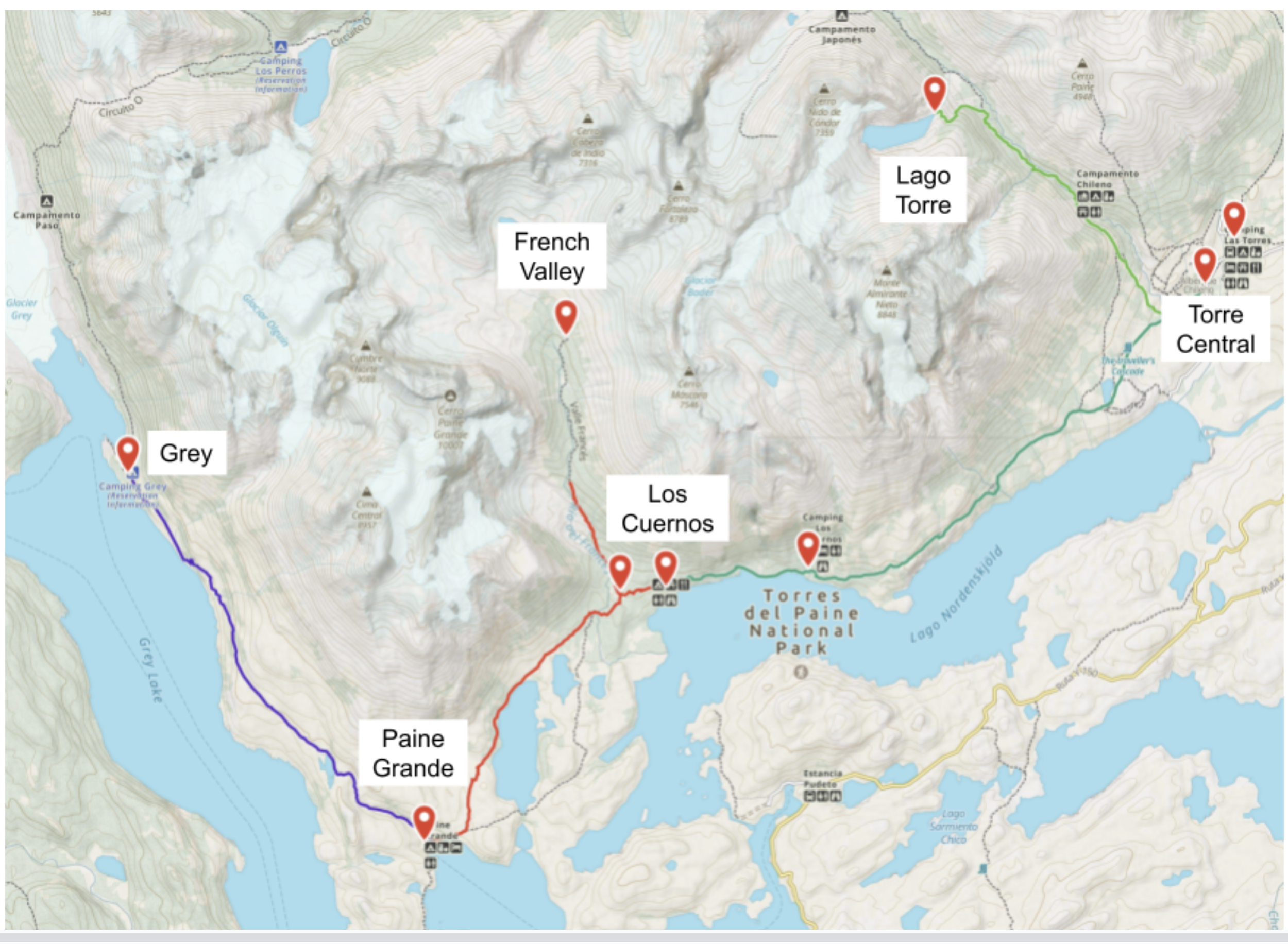
We will be following the Vertice Five-Day W Circuit itinerary while using their tents, transport, and a guide. We have chosen tents because they will be more private and quiet. We will eat breakfast and dinner in the refuges. The refuges will have spotty wifi.
TDP Day 1: Torre Central to Lago Torres. This is an out and back hike so we have options to shorten the hiking length.
TDP Day 2: Hike Torre Central to Los Cuernos. This is a long and mandatory day.
TDP Day 3: Hike Los Cuernos, French Valley, Paine Grande. This is an out and back hike so we have options to shorten the hiking length.
TDP Day 4: Hike to Paine Grande to Grey Glacier.
TDP Day 5: Hike Grey to Paine Grande and travel to Puerto Natales.
Misc Information
Air Travel
It is usually easiest to book a roundtrip flight from your home city to Buenos Aires, Argentina (EZE), and a separate ticket on Aerolineas Argentinas roundtrip flight from Aeroparque (AEP) to El Calafate (FTE). Note that Buenos Aires has two airports, the international (EZE) airport and the domestic Aeroparque (AEP) airport. Allow five hours minimum transfer time between the two airports for customs, transfer, and security. The transfer between Buenos Aires (EZE) and Aeroparque (AEP) is two hours by taxi (~US$50) or shuttle (~US$17 per person, Manuel Tienda Leon).
Inoculations
None required for Americans. More information on the CDC Traveler’s Health page: wwwnc.cdc.gov/travel/destinations/traveler/none/argentina
Visa
None required for Americans. Save your Chile immigration card that will be handed to you upon entering the country, otherwise you will have to pay taxes. Chile has strict agricultural rules so we will only take commercially packaged snacks. Our hotel address on the first night is
Altos de Soberana
Calle 220 181
9405 El Calafate, Argentina
Money
Just in case, bring $2,000 in USD cash each to have the option to pay for most things during your trip including tips for local guides, meals, shopping, and local transport. I guess a good tip would be $100 from each of us in Torres del Paine and El Chalten, so $200 each. The Argentina economy is changeable. Credit cards often work, but that may change. Joe will update these details in October once he gets to Argentina.
Reading
In Patagonia by Bruce Chatwin.
Enduring Patagonia by Gregory Crouch.
The Tower by Kelly Cordes.
The Wager by David Grann.
Climbing Fitz Roy, 1968 by Yvon Chouinard and others.
Rescue Insurance
Required. See International Terms and Conditions for recommendations.
Fitness
Trekking in Patagonia involves consecutive days of walking on up and down on rough trails, at lower altitudes, with a light pack. Training will make the trip more enjoyable and help prevent injury. Showing up without training will compromise your enjoyment and increase your likelihood of injury.
A good measure for fitness is to hike several training days of 10+ miles with 1-3,000 feet of elevation gain on rough trails.
Training
1. Don’t Get Injured! The goal of training is to have a better trek, not the training itself. Don’t push yourself to the max during the training and don’t push through injury. Avoid workouts with big weights. Always back off if you feel aches or pains. And perhaps most important, rest so you can recover and be stronger. You want to be healthy and strong at the starting line.
2. Hire a Personal Trainer. The best athletes get the most coaching. Find a trainer who understands age and understands the outdoors and has significant hiking experience. You’ll learn the right techniques and prevent injury with a good trainer.
3. Determine your Training Zones. This is optional, but helps training. Go to a training facility to determine your training zones, or your heart rate monitor watch may give you good enough zones for your age. The Apple watch does this. The Garmin Fenix is a fancier heart rate/altimeter watch that is popular with mountaineers.
4. Train for Endurance. 1+ times per week. The best way to train for trekking is by trekking. Try to get at least one full day (8 hours) of hiking in per week in the months preceding the trip. Ideally these hikes will be about 10 miles and 1-3,000 vertical feet on rough terrain. Use the footwear and backpack you will use on the trek. Shorter walks during the week also help. These are zone 2 workouts where you can keep a conversation going. Most of your training should be in zone 2.
5. Do Functional Training. 1-2 times per week. These workouts improve your core fitness, strength, balance, and agility. All of these are important for preventing injury during the trek. Common exercises and equipment include light dumbells, Bosu, TRX, agility ladders, body weight squat, and kettle bell swings. It’s easiest to do functional training in a class or with a personal trainer.
6. Train your Cardio. 1 time per week. High Intensity Interval Training (HIIT) in zone 4 or 5 will help with hills by moving up your upper limit, so you’re not trekking near your limit. A common cardio workout is 20-30 minutes of intervals once a week doing hill walking, running, rowing, cycling or stair climbing. Push yourself in cycles of zone 4-5 for 3 minute then take a few minute break for your heart rate to go down. Another cardio option is Tabata workouts with very short bursts of intense exercise—such as on a stationary bike—followed by brief rest periods. A Tabata workout could be 8 rounds of 20 seconds each, with 10 seconds of rest between each round for a total of 4 minutes.
Cost
2 clients: $11,000 each
3 clients: $9,500 each
4+ clients: $8,000 each
Includes
Joe
Local hiking guide in Torres del Paine and in El Chaltén. As needed for local regulations.
All travel expenses for the guide.
Land transportation during the trip.
Lodging on day 0-11.
Park fees and permits.
Breakfast on day 1-11.
Lunches on day 1-11.
Dinners while on the Torres del Paine trek.
Grey Lake catamaran ferry.
Does Not Include
Airfare
Dinners in El Calafate, El Chaltén, and Puerta Natales.
Personal gear (see Patagonia Trekking Gear List).
Beverages including alcohol and bottled drinks.
Gratuities for local workers.
Expenses incurred in the event of early departure (evac fees, transport, extra hotel nights, etc).
Charges incurred as a result of delays beyond Stock Alpine control.
Travel insurance is recommended. See Terms and Conditions below.
Rescue insurance is required. See Terms and Conditions below.

Patagonia Trekking Gear List

International Terms and Conditions
Waiver


