


Snow has Energy?
Wednesday, February 17, 2010 at 8:50AM I've heard friends say "the snow didn't have any energy," or "the new snow was humming with elastic energy." I've been wondering, how can snow have energy? Maybe when it's avalanching, but how about when it's just sitting there?
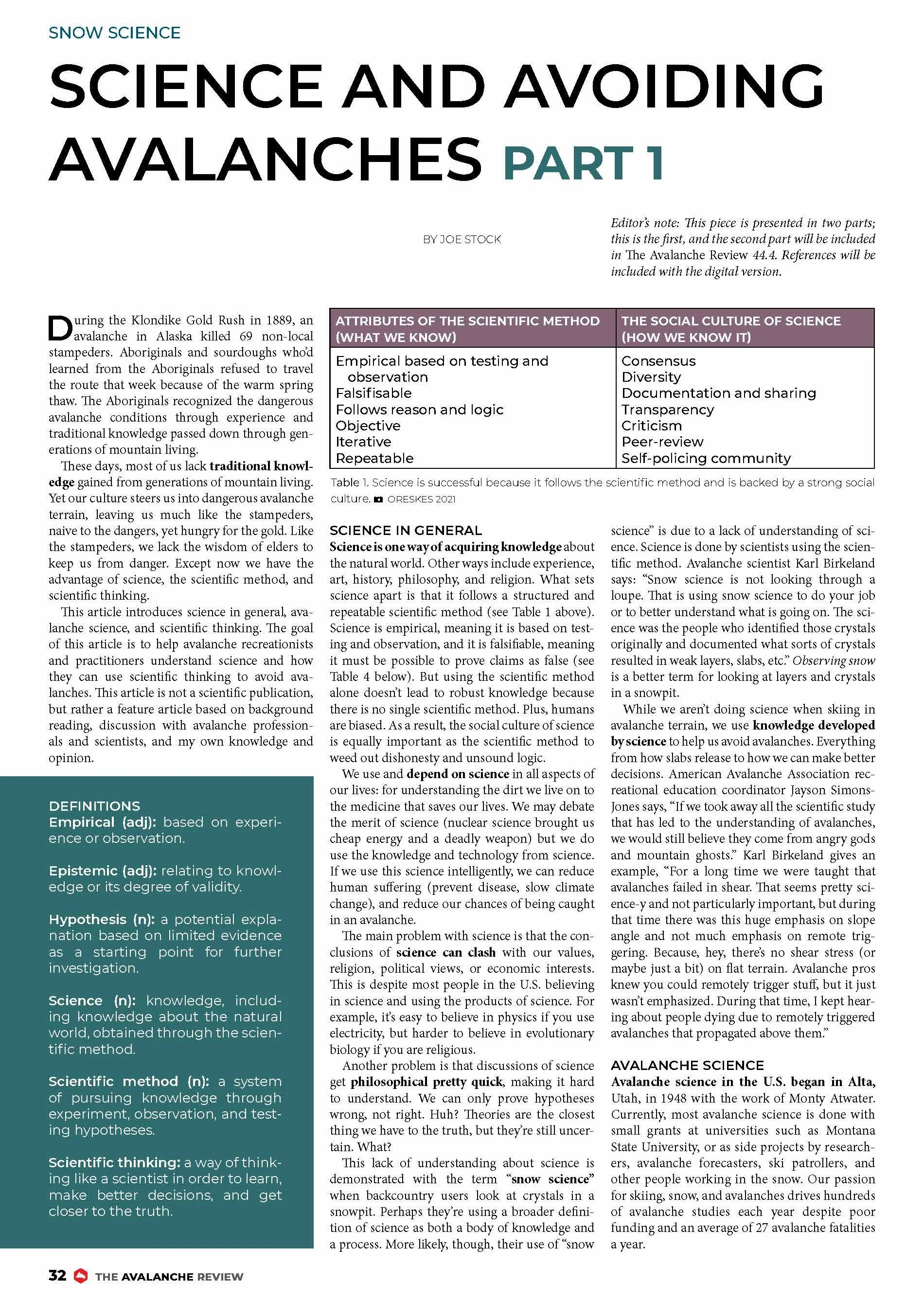
Cathy and Jeff Conaway described energy to me in terms of potential energy that accumulates in a column of snow before the snow settles or the weak layer disipates. Kinetic energy is released when the weak layer is triggered into an avalanche or it consolidates. Sounds like you need a Ph.D in geomagitianism to know if the slope will avalanche or not.
Okay, what really is energy? I need a non-physics answer.
I consulted Tremper's Staying Alive in Avalanche Terrain. He writes "Researchers believe that shear quality does a good job of determining energy in the snowpack...High quality shears break on a clean, planar surface and pop out with 'energy' like they're spring-loaded. Canadians describe them as 'pops and drops,' meaning they pop out with energy or they collapse." Oh, that makes sense. That's why we emphasize shear quality in stability tests.
Energy is also used to describe avalanche release as one of the three slices of the snowpack stability pie: 1) Strength from stability test results, such as the rutshblock or compression test, 2) Energy measured as the shear quality of the failure plane, and 3) Structure of the snow layering measured by yellow flags or lemons. While stability tests and shear quality show us how likely the weak layer is to fail at that spot (the pit location), yellow flags help determine if the failure will spread and cause an avalanche.

My question becomes: must we conduct a compression test and measure shear quality to determine snowpack energy? Not necessarily, I think. Some snowpack has energy that is obvious through red flags: whoomphing, shooting cracks and hollow sounds. You can also feel energy in the snowpack through your skiis, such as punchy conditions from new snow over depth hoar for or a skittery, buried crust.
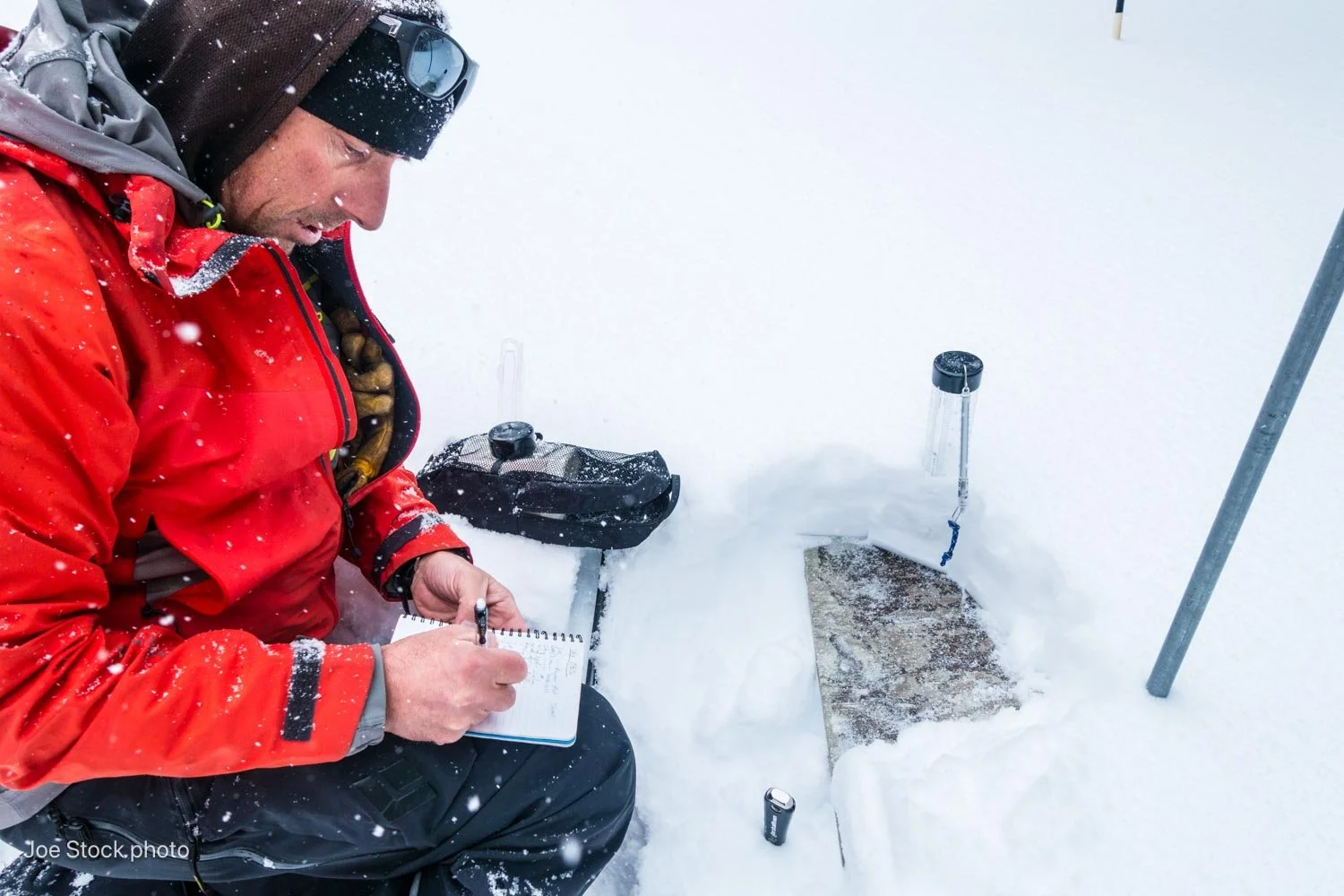
Problematic energy is the type you can't observe through a keen backcountry snow sense. This is the energy you can't see, feel or hear. An example is that lingering depth hoar layer that shows up as a CT25 Q1 at 45 cm in the compression test. As Henry Munter from Chugach Powder Guides put it, "I guess I just don't see how anyone could, see, feel, intuit, or otherwise sense the energy stored in deep slab instabilities without getting some gloves and eyeballs into a pit..."
I'm now thinking there is 'observed energy' and 'measured energy.' What do you think? If you've read this far then you better send me an email!
Joe Lujan from Anchorage sent me this email:
Hey Joe,
I think you make a good point in your spiel about observed and measured energy in the snow. Obviously, stability feels more intuitive to us if we have some way to quantify it. CT25 is safer than CT7, for example. The higher the number, the safer. But I don't think many people consider shear quality or depth. Like you said, CT25 may not be so good if it pops like a mouse trap 45 cm down. Now we may be able to observe this "energy" as we hike, as long as it is a fairly shallow energy. Yeah, I can see shooting cracks in front of my skis, but if those cracks are failing three feet down as I skin, I should get the hell out of there. I am likely observing cracks shooting in the surface snow. This is a common occurrence, but knowing it is shallow, many people push on. So, we have our observed energy in the snow. This is the whoomphing, the shooting cracks. Whatever we notice on the way up. We have the measured energy. The CT scores combined with the shear quality. This is what we "measure" in our stability tests. But I think the unnerving fact is what we don't observe or measure. We won't likely see shooting cracks if the failure is three or four feet deep. Nor will we measure the same weakness in a compression or shear test in every pit we dig. So what do we do? If we tell people to question their pit results, even after noticing no signs of instability on the way up, they will begin to wonder why they dig pits in the first place. But if we tell people to trust the numbers and only the numbers, shy of digging twelve pits in different locations in a single day, I think some bad things will happen. I think the kind of "problematic" instability or energy we are talking about is neither observed nor measured in many cases. It lies somewhere in between. And hopefully when one deals with this kind of "dragon," they either realize that they are not ready for this kind of situation and turn around, or they accept the level of risk. There are many times that you simply can't be sure the snow will not slide, but if you have the experience, knowledge, skiing chops, and confidence to accept that fact, hopefully more often than not, lady luck will shine upon you. So, I guess I'm thinking that there is observed energy, measured energy, but also something else. What exactly that is, I'm not sure. Maybe it's localized energy which is so localized it is hard to observe or measure. We've seen different pit results in different locations. We've felt wierd collapses and density inversions for fifty steps that suddenly disappear just as we begin to grow concerned. We hope these feelings and observations don't slip through the cracks, but again I think it comes down to the inherent risk. We choose to accept our judgment, and accept the fact that maybe we can't sense all energy in the snowpack. But we can find enough facts to make a safe decision that gets us home safely so we can drink beers and reminisce about our day. Let me know if this makes sense. It's late.
Cheers,
Joe
Ryan Hokanson sent me this email on Feb 24:
I think that all snow (or other objects) capable of falling has potential energy, and when it falls that potential energy is converted to kinetic energy. When a snow slope is pasted up high on a hill, not avalanching yet, it has high potential energy and no kinetic energy. As it falls (avalances) the potential energy is converted to kinetic energy, which is used to snap trees in half and demolish houses.
I think when people talk about 'energy' in a snowpack, they're really talking about how easy it would be to trigger this conversion from potential energy to kinetic. The ease of doing this is influenced by slope angle, tensile strength of the snowpack, sliding surfaces, natural anchors, etc. I think if you look at it from a purely physics viewpoint, any 100 gram falling X distance has the same energy as any other 100 gram object falling X distance. Thus, ALL snow has the same potential energy as an identical MASS of snow capable of falling the same distance. It's really stability they're talking about, ie, how easily the energy is released.
Now post some euro ski photos!!!!!!!!
Hope you're having fun...R
Mike Bromberg from Crested Butte sent me this email on Feb 26:
Anyways there are some very interesting points in your post with regards to "observable energy"- remember that shear quality is only one piece of the ever expanding jigsaw puzzle and that fracture character (the pops and drops) and ultimately the propagation potential is more important when determining "energy" in the snowpack. Many nowadays, especially Canadians, will argue that fracture character trumps all other observations with regards to snowpack test observations, hence we now code the compression test without the # of taps because the tap strength is highly subjective (CTM @ 45cm instead of CTM14 @ 45). http://www.ucalgary.ca/asarc/files/asarc/FractureCharacterIssw02.pdf is a good paper. Most agree that the Q scale (even in it's revised form) is not exhaustive enough of an observation tool, thus the fracture character is often preferred.
Also, what about the actual mechanics of a natural avalanche? It all adds up when we talk about stress exceeding strength and failure occurs in terms of an artificial trigger, but little is known about fracture mechanics in a natural avalanche. This paper below is super interesting on that topic. Yes this is somewhat off topic, but interesting. http://www.wsl.ch/personal_homepages/schweizj/publications/Schweizer_Review_slab_release_ISSW1998.pdf
I guess to answer your question the same way you did: No, you don't necessarily need to dig a profile or conduct a compression test to determine if there is energy within the snowpack, however many would suggest that any of the large column tests ECT, PST, and RB would be more beneficial in forecasting propagation propensity and therefore "energy" than a CT anyways.
Given your test results you then have some frame of reference for how that particular snowpack structure reacts during tests, other than just how it feels under foot - an informed guess at best.
Good stuff,
I hope your getting wicked d-sendy out there! where are the trip reports?
Mike